September 22, 2013

peach tree gummosis

2013.09_peach tree gummosis
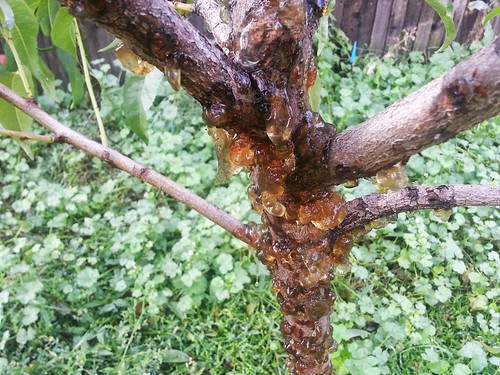
Our peach tree got gummosis bad, up and down the whole trunk. I've never seen globs this big. It makes be realize how the amber-preserved mosquitoes from Jurassic Park could really happen.

Gummosis is just the descriptive symptom. Sifting through the internats, it is most likely the tree's reaction to holes drilled by an insect, peach tree borer, or to a fungus, cytospora canker.

I read that some dwarf fruit trees get gummosis as a matter of course, when watered heavily. Ours is a semi-dwarf, but this happened after Colorado's week of record-setting rains (we fortunately didn't get any flooding or hail, but some nearby farms got pretty devastated by hail).

Peach tree borer seems unlikely since they usually burrow below the soil/mulch surface. If it is the canker, that's bad, since you're supposed to remove infected areas and the whole trunk is infected. I'm hoping the tree will pull through. I'm continuing to give it plenty of water.

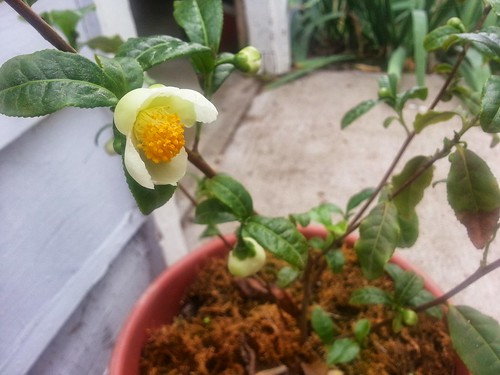
camelia sinensis blossoms

2013.09_blooming tea plant
Our tea plant blossomed today. It, and the lime tree we got in the spring, seem to be doing fairly well. I've had them on the shady north side of the garage, tucked between irises and alliums. They stay pretty moist there. Surprisingly, tea can be planted as far north as Toronto with the right microclimate, which includes the shady north side of buildings.

You can make a non-caffeinated tea from the flowers or eat them, but I want to see what happens with fruiting.

September 13, 2013

deluge of tomatoes


Prior to the deluge of rain along Colorado's Front Range, we had a deluge of tomatoes ripen in our garden. I canned this pile of tomatoes last weekend.  The resulting 5 pints of pasta sauce will certainly taste good in the winter!

September 7, 2013

share your skills! worm composting class

2013.08.26_worm bin class10

Exciting things are happening in Wheat Ridge!  We are part of a newly developing group called Live Local Harvesters that is building community around gardening, urban homesteading, livestock, local agriculture, etc.  We have monthly potlucks sometimes accompanied by food politics movies.  We have informal skill sharing classes led by community members.  We have informative barn raising events like for example a group set up drip irrigation in one person's backyard and everyone left knowing how to do it in their own yard.  We have a message board where people can ask questions, post new discoveries, or host improptu events.  It's all very fluid and energized which is very exciting.

Anyway, Eric recently taught a skill share class on worm composting and building worm composting bins.  Everyone who attended and wanted a worm bin left with a worm bin that they helped to build and some worms.  It was an excellent community building event! 

August 31, 2013

wax moths in the beehive

2013.08.30_wax moth infestation 05
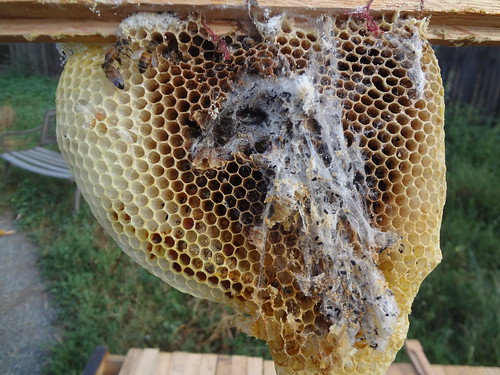
Well, our honeybee colony's population has continued to decline (though I've continued feeding them) and yesterday I looked in the observation window and discovered that wax moth larvae had destroyed about half of the comb. The adult moth lays eggs in the comb and when the larvae hatch, they plow through the comb, eating everything in their path: beeswax, honey, stored pollen, brood, and even wood.

This is a sign the colony is too weak to defend itself–a strong hive would not let this happen. Perhaps if I had done an inspection of the combs more recently (pulling each one out to look at it), I would have discovered the moth larvae sooner. Then it may have been contained to one comb, as opposed to three.

There's not much you can do about wax moth larvae. I brushed the bees off the infested comb, squished the larvae (would make good chicken food), and saved some of the more intact comb to try to reuse. I put this comb in the freezer to kill any moth eggs.

It doesn't seem likely that the colony will survive the winter. I've been seeing yellow jackets in the hive as well, another sign that the hive is weak. It's possible that the queen is already dead, since I didn't see any new eggs or (bee) larvae in the hive, just a few capped brood cells. Sad, but I feel we did everything we could to improve their chances of survival. At least we have some built comb we can save for future colonies, and we've gained some experience.

To close, some interesting words on wax moths, from Les Crowder and Heather Harrell, authors of Top-bar Beekeeping: Organic Practices for Honeybee Health:

Although we may not see them, there are wax moths, either latent or active, in all beehives. Pregnant moths have a scent-cloaking ability and slip into the hives past the guard bees and lay eggs. Tiny threadlike larvae then begin chewing their way through the combs, eating cocoon silk, honey, pollen, bee larvae, and beeswax. Wax moth larvae actually are unable to digest combs of clean, pure beeswax and instead thrive on old black combs filled with bee feces and layers of cocoons.
Sometimes we hear of hives succumbing to wax moth, but in many cases this is because all the combs in the hive simply had gotten too old and dirty to house bees, so the bees allowed the wax moths to take over. In a healthy hive, the bees in a colony are constantly weeding out wax moth larvae. If the hive gets sick or queenless and the population of bees diminishes, wriggling masses of wax moth larvae proliferate and destroy the hive. However, if a hive is healthy and strong, the bees can keep them at bay and even use them to remove old, unsafe combs. We consider wax moths to be symbiotic organisms in a beehive, like the wrecking ball that tears down an old condemned building to make space for new construction.
Sure enough, the old combs I had hung from top bars to give the bees a head start were the ones most destroyed by larvae.

August 18, 2013

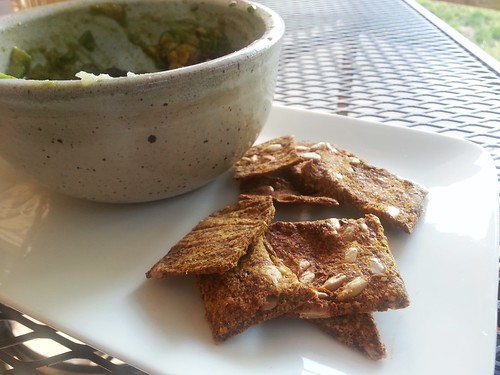
flax and carrot pulp crackers (gluten-free)

2013.08_carrot crackers
I wasn't going to post about these, but they came out so good. It is amazing that they are gluten-free, since they are so flaky and crispy and satisfying when you want something that goes "crunch."

A while back, I juiced a bunch of carrots and froze the carrot pulp that was extracted, since I heard you could use it to make crackers. So that's what I did. Here is the recipe that I used: Flax & Carrot Pulp Ginger Crackers. Basically, you grind the flaxseed (coffee grinder works well) and combine with the juicer pulp and some water and spices.

I also added sunflower seeds, some lemon juice, and salt. I baked them instead of dehydrating since I didn't feel like rolling them out in a doughnut shape. I used my classic technique of perforating the rolled out "dough" with a pizza cutter halfway through baking.

I have a lot more carrot pulp in the freezer, so I'll definitely be making more of these. I'll have to make a batch with amaranth seeds since I've found those to be really nice in crackers.

August 17, 2013

pottery

2013.08_pottery

I am a big fan of pottery.  I love the handmade imperfect beauty of it.  I also appreciate that it is a functional art form—you mean I can eat my granola out of that??  Pottery can be pricey though so most often I find mine at thrift stores.  Occasionally, when I come across an artist I really like (ahem Alex Watson), I will drop the money for a new piece.

Needless to say, I've been wanting to take a wheel throwing pottery class for years now. It just so happens that we moved down the street from an art studio that offers pottery classes, so I signed myself up!  These are my first pieces.  While they are not my favorite, it is super exciting to be learning and experimenting.  The process is intriguing too—it is meditative and humbling, you can suggest a form but you can't force it, and similar to watercolor you have to know when to stop and how to accept what is.

August 14, 2013

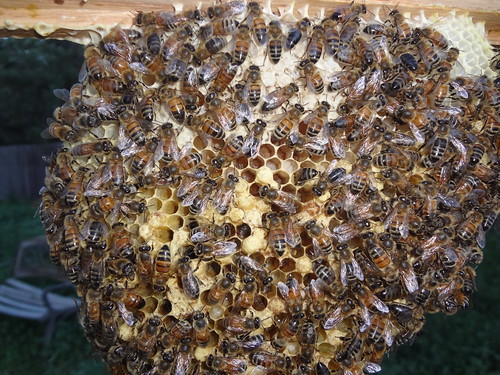
moment of truth for the bees

bee metropolis
Today, Wednesday, August 14, 2013 is the moment of truth for our colony. That is six weeks after we installed the colony. Honeybee workers live an average of six weeks during the busy summer, so all the worker bees in the colony will have been born and raised in our backyard hive.

The population has dropped to about half of what it was when first installed. This made me very nervous as I inspected the combs the other day, since I had only seen a few tiny eggs during the last inspection. I was relieved to see a spattering of curled up white larvae and capped brood cells:
2013.08_bees brood
Not as much brood as I'd like to see, but still reassuring. However, it looks like much of the brood is has domed caps, indicating that it is drone brood. Hopefully there is at least some worker brood, or else we might have an unmated queen, who can only produce unfertilized eggs that become drones. While drones propagate the genes of the colony, they do not "work" and don't contribute to the immediate survival of the hive. In fact, they consume hive resources. Naturally, they are kicked out of the hive in the autumn.

I was reassured to learn that worker bees live 4–9 months through the winter season, and that a colony's population fluctuates: from 60,000–80,000 in the summer to 20,000–30,000 in the winter.

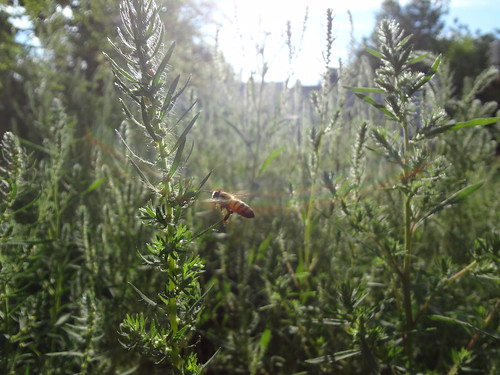
The weeds that make up the majority of our backyard right now are waist high. I had worried that they had gone to seed before we could cut them back. But the other day I was amazed to see a veritable metropolis of bees, like an army of window washers, furiously scanning up and down the stalks of tiny flowers so small I didn't know they were flowers until I saw the bees' interest in them. They were really loving the one weed that dominates the backyard that I haven't been able to identify (see top photo). It made me really glad that we hadn't cut it all back yet. It seems like it would be difficult to time the cutting to be after flowering and before seeds are mature. We may do the cutting in stages, so that we don't destroy all of the potential nectar sources/habitats at once.

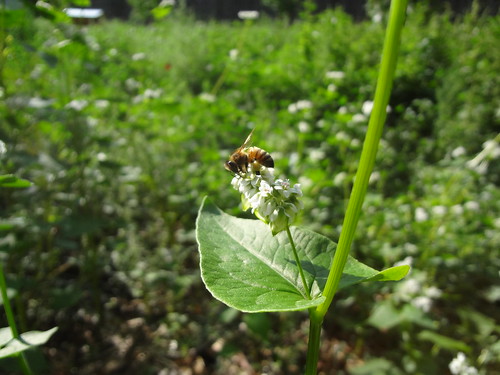
The bees are also loving the buckwheat that I dispersion seeded in an area loosely mulched with wood chips:
2013.08.06_bee on buckwheat

August 12, 2013

recent harvest

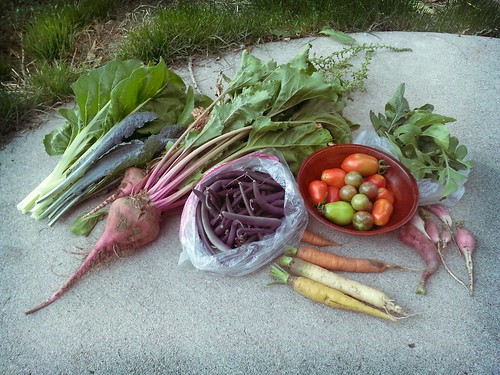
2013.08_some harvest
Just wanted to capture this for our record. I picked some tomatoes and a lot of purple string beans. I also harvested a number of things that we had mostly forgotten about or given up on: carrots, beets, radishes, chard, and kale. We even had three kohlrabi plants that are finally doing okay.

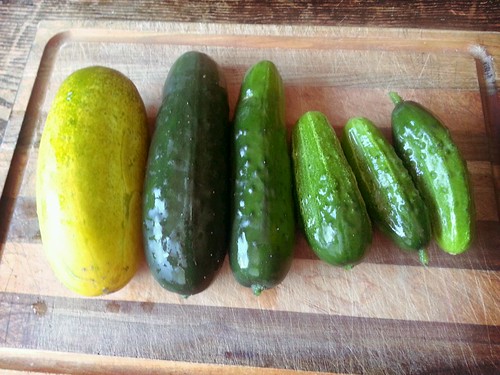
I also cleared the weeds around the cucumber plants and discovered a bunch of ripe cucumbers:
2013.08_cucumbers

August 11, 2013

blossom end rot

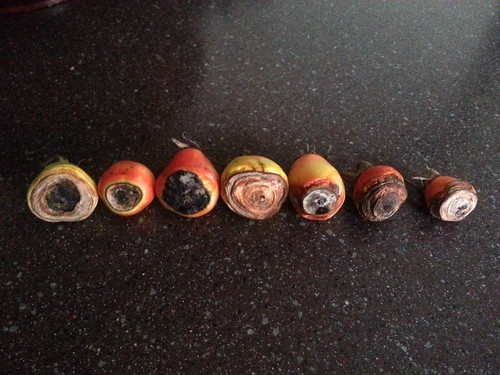
2013.08_blossom end rot
The first set of ripe tomatoes we've gotten have all had black or brown spots on their bottoms, which looks like blossom end rot. Anna from The Walden Effect, explains that it isn't caused by a virus, bacterium, or fungus, but rather by calcium deficiency. This doesn't necessary mean you need to go crush up some eggshells by your tomato plants; Anna explains that a range of factors, from drought, root damage, excessive heat, or even fast plant growth, can lead to calcium deficiency.

Luckily, blossom end rot is most common on early season tomatoes, and, as we've noticed in our garden, the problem diminishes with subsequent sets of ripening tomatoes. If the spot is small, you can simply cut it off and enjoy the rest of the tomato.